
The True Cost of Water Tanks in Kenya: GRP vs. Plastic vs. Concrete

The True Cost of Water Tanks in Kenya: GRP vs. Plastic vs. Concrete
Water storage is a foundational part of every modern infrastructure project in Kenya and across East Africa — from residential borehole systems to large-scale municipal supply, industrial processing, commercial complexes, agricultural irrigation, high-rise towers, and institutional facilities. Yet despite this importance, many developers, engineers, facility managers, and even procurement teams evaluate tanks purely based on purchase price, often overlooking the far more significant lifecycle costs, maintenance complexities, installation demands, and water quality implications.
This comprehensive guide breaks down the true cost of the three most widely used water tank materials in Kenya today — Glass Reinforced Plastic (GRP), Plastic (HDPE/Polyethylene), and Concrete. We evaluate them based on total cost of ownership, installation demands, durability, hygiene, and long-term economic value.
GRP Water Tanks in Kenya
Glass Reinforced Plastic (GRP) tanks have rapidly become the preferred solution for medium and large-scale engineered water storage projects in Kenya. GRP is a composite material made from specially formulated resin reinforced with fiberglass matting. When manufactured into modular panels, GRP enables the construction of tanks of virtually any capacity, footprint, or height.
Why GRP Water Tanks Are Becoming the Standard in Engineering Projects
1. High Strength-to-Weight Ratio
GRP panels are significantly lighter than concrete but incredibly strong. This reduces transportation cost, eases lifting requirements, and minimizes foundation preparation expenses — a major cost advantage in high-rise or remote sites.
2. Complete Corrosion Resistance
Unlike steel and concrete — both of which degrade under chemical or environmental exposure — GRP is non-corrosive. This eliminates major long-term repair or relining costs.
3. Excellent Water Hygiene
GRP surfaces are smooth, non-porous, and resistant to microbial growth. For drinking water applications, this ensures high hygiene standards and lower cleaning frequency.
4. Fast Installation
GRP sectional panels are assembled on-site by trained technicians. Installations that would take weeks in concrete often take a few days with GRP.
5. Ideal for Challenging Delivery Conditions
Because GRP panels are lightweight and modular, they can be transported to remote areas, difficult terrains, or tight urban sites without oversized transport or cranes.
👉 To learn more about how GRP panels work, visit the Aquosys GRP panels page.
Sectional GRP Water Storage Tanks
Sectional tanks are built using pre-manufactured GRP panels that are bolted together on-site to form a fully sealed, uniform water tank. This modular system allows for:
-
Custom sizes from 1m³ to several million litres
-
Flexible installation in constrained spaces
-
Easy transportation in small trucks
-
Quick assembly and disassembly
-
Lower maintenance due to replaceable components
Aquosys Limited is one of the leading manufacturers and installers of sectional GRP water storage tanks in Kenya and East Africa. Explore previous installations:
👉 Our Portfolio
👉 Gallery
Advantages of GRP Tanks vs. Steel/Concrete
This is one of the most important cost comparisons for developers and engineers. While many assume steel or concrete are cheaper due to high local availability, the reality is more complex.
Below is a detailed comparison based on engineering, cost, and lifecycle performance.
GRP Tanks vs. Steel Tanks
✔ Corrosion Resistance
Steel tanks — unless stainless — will inevitably corrode. Protective coatings must be applied, monitored, and frequently reapplied. Corrosion affects water quality and structure.
GRP does not corrode. Zero coating cost. Zero metal loss. Zero long-term degradation.
✔ Maintenance Cost
Steel requires periodic painting, sandblasting, welding repairs, and inspection.
GRP requires minimal maintenance and no corrosion-related repairs.
✔ Thermal Performance
Steel tanks absorb heat rapidly, increasing bacterial risk and requiring insulation.
GRP naturally resists external temperature transfer.
✔ Total Cost of Ownership
Though steel may be cheaper upfront, over 10–15 years GRP is significantly cheaper when factoring in maintenance and hygiene.
GRP Tanks vs. Concrete Tanks
Concrete tanks are widely used in Kenya for underground reservoirs. While cost-effective for long-term permanent installations, they have notable limitations.
✔ Construction Time
Concrete construction requires formwork, steel reinforcement, curing time (3–4 weeks), waterproofing, and leak testing.
GRP tanks are assembled in days.
✔ Leak Risks
Concrete is porous and prone to cracking and seepage. Waterproof lining is required.
GRP is impermeable and factory-manufactured for consistency.
✔ Foundation Requirements
Concrete structures require large reinforced slabs and significant excavation.
GRP tanks require smaller, lighter bases — saving civil works cost.
✔ Price Volatility
Cement, steel bars, and formwork costs vary frequently in Kenya.
GRP panel prices remain stable, predictable, and easy to quote.
👉 Learn more about GRP characteristics and benefits at: Characteristics
Applications of GRP Tanks in East Africa
Because of their flexibility, GRP tanks are ideal for numerous industrial, commercial, and municipal applications.

1. Municipal Water Supply
County governments and water utilities increasingly prefer GRP because:
-
They can be installed quickly
-
They support very large capacities
-
They resist corrosion from treated water
-
They are hygienic for potable water
2. Industrial Manufacturing & Processing Plants
Industries such as food processing, pharmaceuticals, textiles, and mining rely on:
-
Clean process water
-
Chemical resistance
-
High reliability
GRP meets these requirements better than plastic or concrete.
3. High-Rise and Rooftop Water Storage
GRP is ideal for rooftop applications due to:
-
Low weight
-
High strength
-
Modular assembly without cranes
This significantly reduces structural load costs in high-rise construction.
4. Hospitality, Hospitals & Institutional Storage
Hotels, resorts, universities, schools, and hospitals demand uninterrupted clean water. GRP sectional tanks offer:
-
Superior hygiene
-
Reduced risk of microbial contamination
-
Easy cleaning
-
Long life span
5. Remote and Hard-to-Reach Locations
GRP sectional panels easily reach:
-
Rural areas
-
Mountain regions
-
Off-grid sites
-
Areas with poor road networks
Plastic tanks, often transported whole, face logistical limits at sizes above 10,000–20,000 litres.
Cost of GRP Tanks in Kenya
To understand the true cost of water tanks, we must move beyond the simple purchase price and evaluate Total Cost of Ownership (TCO).
This includes:
1. Purchase Price
GRP panels cost more per unit than plastic, but less than steel and high-quality fabricated concrete.
2. Transportation Cost
Plastic tanks above 10,000–20,000 litres require large trucks, escorts, and sometimes route surveys.
Concrete tanks require special equipment and heavy trucks.
GRP panels are compact and lower cost to transport.
3. Foundation Preparation
Concrete tanks require the most reinforced slabs.
Plastic tanks require medium-strength slabs.
GRP tanks require the smallest slabs.
4. Installation & Labour Cost
Concrete requires:
-
Skilled masons
-
Steel fixers
-
Shuttering carpenters
-
Water curing management
Plastic tanks require minimal labour but are limited in size.
GRP requires trained technicians but is significantly faster and cheaper than concrete assembly.
5. Maintenance Costs
Concrete requires ongoing crack repairs and waterproofing.
Plastic requires UV protection and frequent cleaning.
GRP tanks require minimal long-term maintenance.
👉 To see how Aquosys installs large GRP tanks, visit: Installation
GRP vs. Plastic vs. Concrete — True Cost Breakdown
Below is a detailed comparison based on Kenyan conditions.
Small Domestic Applications (500–10,000 litres)
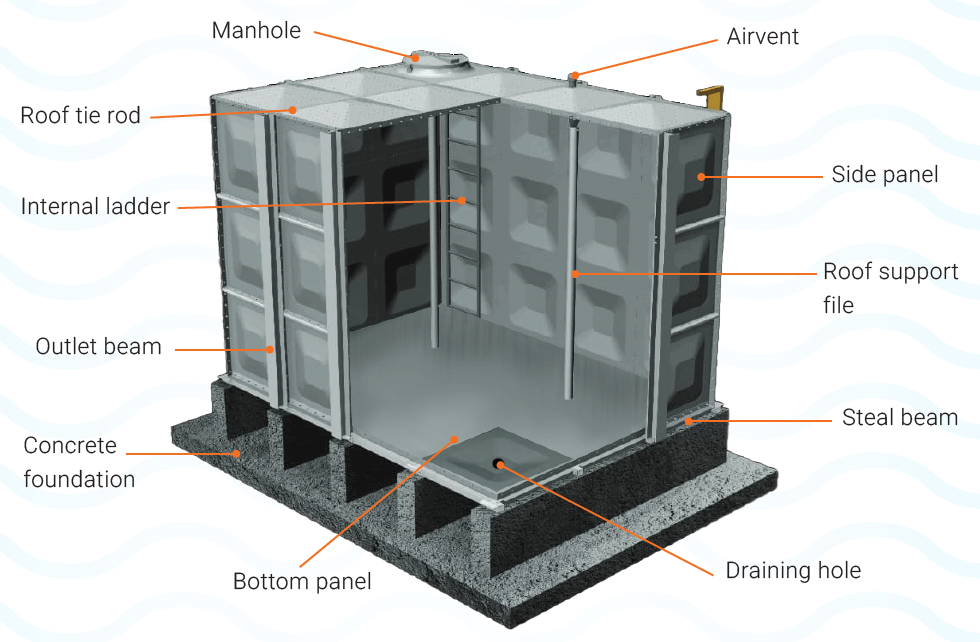
-
Best Option: Plastic tanks (lowest upfront cost)
-
Limitations: Deformation, UV degradation, limited lifespan
-
When to choose GRP: High hygiene needs, rooftop structural limits, or commercial applications
Medium Commercial & Institutional Facilities (10,000–200,000 litres)
-
Best Option: GRP sectional tanks
-
Why:
-
More hygienic than plastic
-
Faster and cheaper than concrete
-
Easy to transport
-
Long-term reliability
-
Large Industrial & Municipal Storage (200,000 litres to several million litres)
-
Best Option: GRP for above-ground applications
-
Concrete Alternative: For underground basins or extremely large municipal tanks
-
TCO Advantage: GRP is cheaper and faster for most above-ground reservoirs
High-Rise Rooftop Installations
-
Best Option: GRP
-
Why:
-
Lightweight
-
Modular
-
No cranes required
-
Superior hygiene
-
Plastic deforms under pressure and concrete is too heavy.
Installation and Maintenance of GRP Tanks
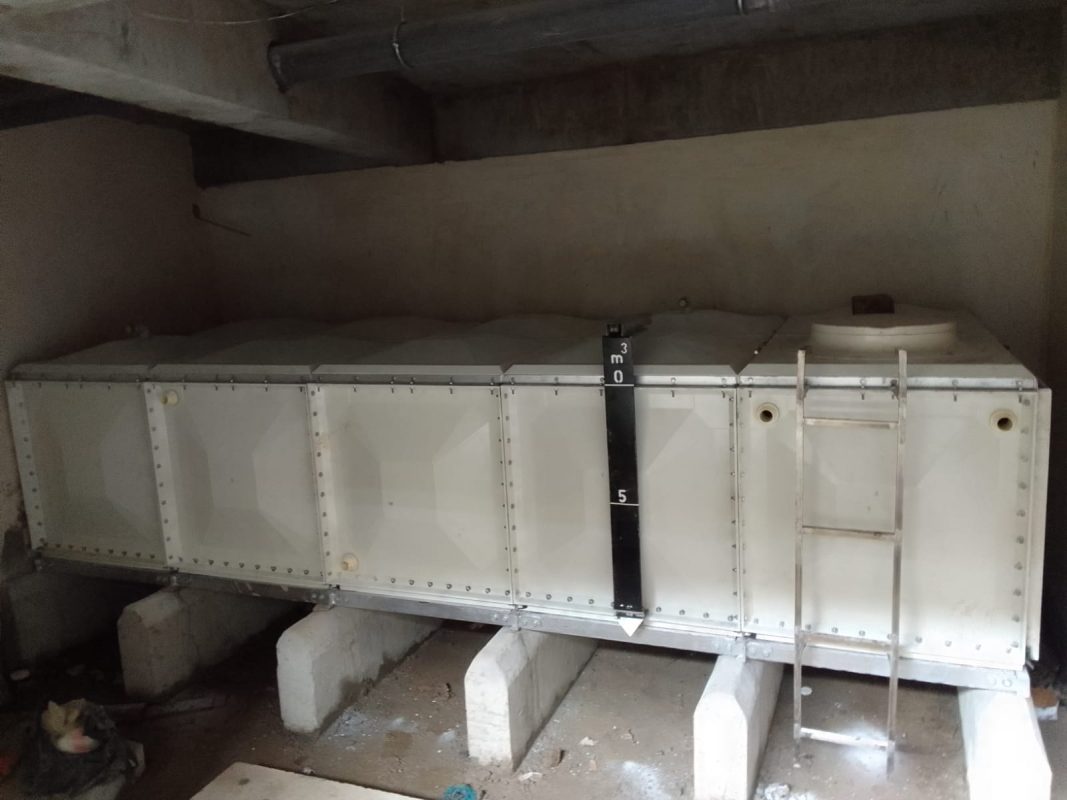
sectional water storage tanks
Proper installation greatly influences long-term cost.
Installation Steps
1. Foundation Preparation
A compacted base and reinforced slab is built. This slab is smaller and lighter than what concrete tanks require.
2. Panel Assembly
Certified technicians align and bolt panels using torque-controlled fasteners.
3. Sealing
Special gaskets are inserted between panels for waterproofing.
4. Internal Reinforcement
Depending on tank size, Aquosys installs internal tie-rods and external reinforcements.
Learn more: 👉 Reinforcement
5. Hydrostatic Testing
The tank is filled to test for leaks.
6. Disinfection & Commissioning
Once tested, the tank is cleaned, disinfected, and handed over.
Maintenance Requirements
GRP requires:
-
Visual inspections
-
Occasional cleaning
-
Checking gaskets
Concrete needs crack repair and waterproofing.
Steel needs repainting.
Plastic needs UV-care and structural support.
👉 Aquosys provides safety and usage guidelines here: Caution
Why Aquosys Limited Is the Leading Manufacturer & Installer of GRP Tanks in East Africa
Aquosys Limited provides:
✔ Fully engineered sectional GRP tank systems
✔ Nationwide installation support
✔ Fast lead times
✔ Custom sizes for large-scale projects
✔ Experienced technicians for assembly and commissioning
✔ Strict hygiene and quality standards
✔ Projects across Kenya, Uganda, Tanzania, Rwanda, South Sudan & Ethiopia
👉 Learn more about the company: About us
Final Conclusion — Which Tank Is the Best Value in Kenya?
Plastic Tanks
Best for small domestic sizes due to low upfront cost. Not ideal for large projects or long-term hygienic water storage.
Concrete Tanks
Best for underground reservoirs and extremely large municipal basins. Higher construction cost and long timelines.
GRP Tanks
Best overall balance of cost, durability, hygiene, installation speed, and long-term value.
Ideal for commercial, industrial, municipal, institutional, and high-rise applications.
When evaluating long-term cost, water quality, structural integrity, and installation constraints — GRP wins across most categories.
Call to Action — Get a Quote from Aquosys Limited Today
COUNTRYWIDE PROJECT SUPPORT AVAILABLE
✔ Expert installation & engineering support
✔ Large-scale & custom designs available
✔ Serving Kenya, Uganda, Tanzania, Rwanda, South Sudan, Ethiopia & beyond
Contact Aquosys Limited Today
📧 sales@aquosys.co.ke
📞 +254 754 750 750 | +254 729 749 749
👉 Submit your project details here: Contact Us

